Nafeesa Parveen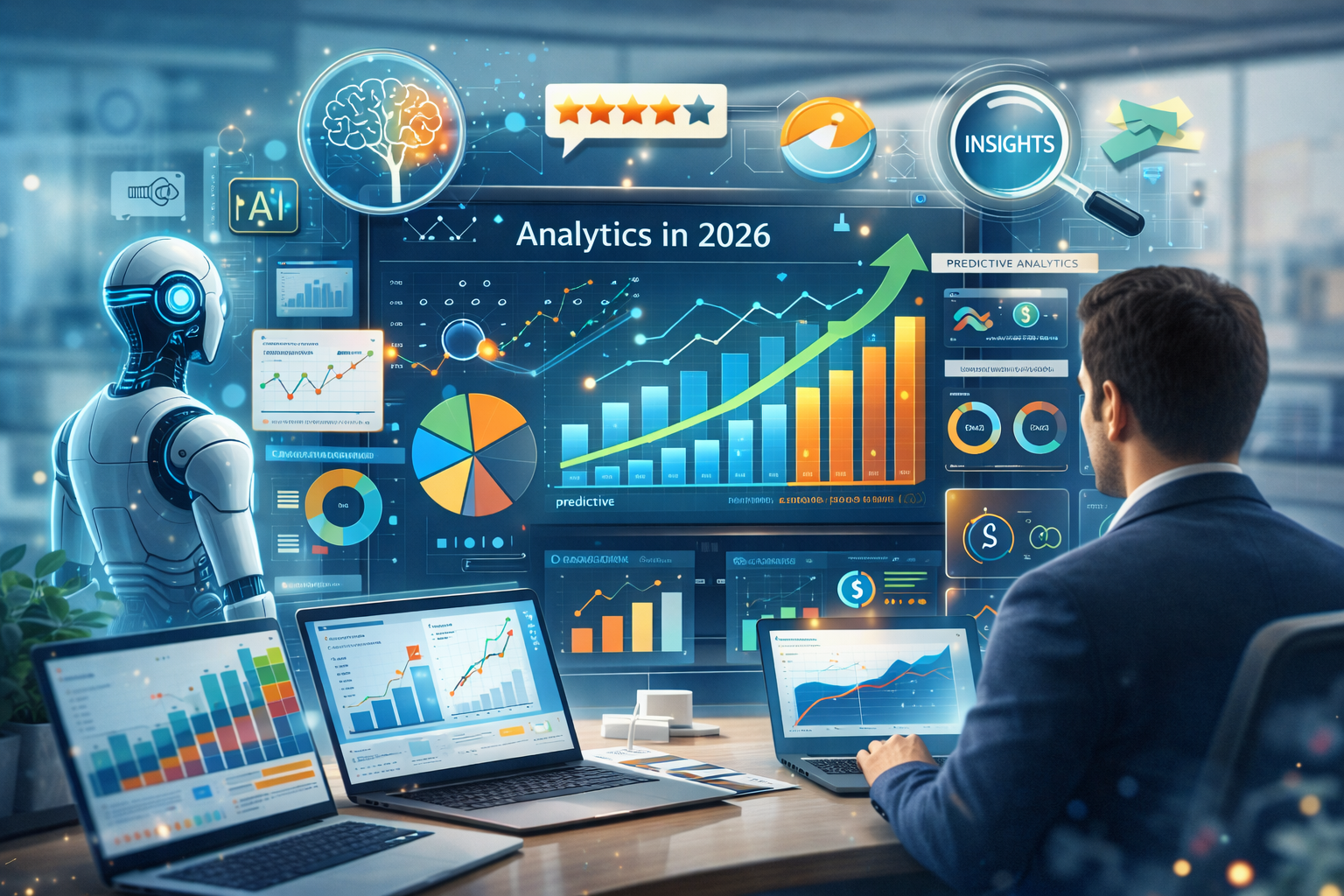
Advanced analytics and AI-powered insights enabling businesses to make smarter, faster, and data-driven decisions in 2026.
Analytics in 2026: How Data is Driving Smarter Decisions
Introduction
In 2026, analytics has become the backbone of smart decision-making. Businesses, governments, startups, and even individuals rely on data to understand what is happening, why it is happening, and what actions should be taken next. Decisions are no longer based on guesswork or intuition alone. They are driven by facts, patterns, and insights extracted from data.
With the rapid growth of digital platforms, mobile devices, artificial intelligence, and cloud computing, the amount of data generated every day is enormous. Analytics helps convert this raw data into meaningful insights that improve efficiency, reduce risks, and increase profitability.
This blog explains analytics in a simple and detailed way so beginners can clearly understand how data is shaping smarter decisions in 2026.
What is Analytics? – Analytics in 2026
Analytics is the systematic process of collecting, cleaning, analyzing, and interpreting data to discover useful information and support decision-making.
In simple terms:
Analytics means understanding data so that better decisions can be made.
For example:
- Businesses analyze sales data to know which product sells the most.
- Websites analyze visitor data to understand user behavior.
- Banks analyze transaction data to detect fraud.
In 2026, analytics is used in almost every industry because data is available everywhere.
Why Analytics is Crucial in 2026 – Analytics in 2026
The importance of analytics has increased significantly in 2026 because of three main reasons:
1. Massive Data Generation
Every digital activity creates data—online shopping, social media, mobile apps, payments, and sensors. Without analytics, this data has no value.
2. Faster Decision Requirements
Markets change quickly. Analytics allows businesses to make real-time decisions instead of waiting for monthly or yearly reports.
3. Competitive Advantage
Organizations using analytics outperform competitors by predicting trends, understanding customers, and optimizing resources.
In short, analytics helps organizations act smarter and faster.
Types of Analytics Explained – Analytics in 2026
Analytics is divided into four main types, each serving a specific purpose.
Descriptive Analytics
Descriptive analytics focuses on what happened in the past.
It summarizes historical data to give a clear picture of performance.
Examples:
- Monthly sales reports
- Website traffic summaries
- Revenue dashboards
Purpose:
To understand past performance using charts, graphs, and reports.
Descriptive analytics is the foundation of all analytics.
Diagnostic Analytics
Diagnostic analytics explains why something happened.
It goes deeper into data to find causes and relationships.
Examples:
- Why did sales decrease last month?
- Why did customer complaints increase?
Purpose:
To identify problems and their root causes.
This type of analytics helps organizations correct mistakes and avoid repeating them.
Predictive Analytics
Predictive analytics answers what is likely to happen next.
It uses historical data, statistical models, and machine learning algorithms to make forecasts.
Examples:
- Predicting future sales
- Identifying customers likely to stop using a service
- Forecasting demand for products
Purpose:
To prepare for the future and reduce uncertainty.
In 2026, predictive analytics is widely used because of advanced AI tools.
Prescriptive Analytics
Prescriptive analytics suggests what actions should be taken.
It combines insights from all previous analytics types and recommends solutions.
Examples:
- Suggesting the best pricing strategy
- Recommending inventory levels
- Advising marketing budget allocation
Purpose:
To guide decision-makers toward the best possible outcome.
This is the most advanced and powerful form of analytics.
Role of Artificial Intelligence in Analytics
Artificial Intelligence (AI) has transformed analytics in 2026.
AI enables systems to:
- Analyze huge datasets quickly
- Identify hidden patterns
- Automate insights
- Learn from data continuously
How AI Improves Analytics
- Automation: Reports and dashboards are generated automatically.
- Accuracy: AI reduces human errors.
- Speed: Insights are available in real time.
- Scalability: Large datasets can be processed easily.
AI-driven analytics allows businesses to move from reactive decisions to proactive strategies.
How Analytics Drives Smarter Business Decisions
Analytics supports decision-making in multiple business areas.
Marketing Decisions
Marketing teams use analytics to:
- Measure campaign performance
- Track customer behavior
- Improve conversion rates
- Optimize advertising spend
Instead of guessing, marketers rely on data-backed insights to increase ROI.
Financial Decisions
Analytics helps finance teams:
- Forecast revenue
- Control costs
- Manage risks
- Plan investments
Financial decisions become more accurate and reliable with data.
Operational Decisions
Operations teams use analytics to:
- Improve supply chains
- Reduce delays
- Optimize inventory
- Increase productivity
Analytics improves efficiency and reduces operational costs.
Customer Experience Decisions
Businesses analyze customer data to:
- Personalize services
- Improve satisfaction
- Reduce customer churn
- Build long-term loyalty
In 2026, personalization is completely data-driven.
Popular Analytics Tools in 2026 – Analytics in 2026
Several tools are commonly used for analytics.
Google Analytics 4 (GA4)
Tracks website and app user behavior.
Power BI
Used for business intelligence and dashboards.
Tableau
Advanced data visualization tool.
Looker Studio
Cloud-based reporting and analytics platform.
AI Analytics Platforms
Provide automated insights and predictions.
These tools make analytics accessible even for beginners.
Real-World Applications of Analytics – Analytics in 2026
E-commerce
Predicts customer purchases and improves recommendations.
Healthcare
Improves patient care and disease prediction.
Banking
Detects fraud and manages credit risks.
Education
Tracks student performance and learning patterns.
Analytics improves outcomes across industries.
Amazon Marketing in 2026: Complete Guide for Beginners
Introduction
Amazon in 2026 is not just an online marketplace — it is one of the most powerful digital marketing platforms in the world. Millions of customers search for products daily, and brands compete heavily to capture attention.
Benefits of Data-Driven Decisions – Analytics in 2026
Using analytics leads to:
- Higher accuracy
- Reduced risks
- Better planning
- Increased profitability
- Stronger competitiveness
Data-driven organizations make confident decisions.
Challenges in Analytics – Analytics in 2026
Despite its benefits, analytics faces challenges:
- Data privacy concerns
- Cybersecurity threats
- Poor data quality
- Skill shortages
- High costs
In 2026, ethical data usage and security are major priorities.
Skills Needed for Analytics in 2026 – Analytics in 2026
To work in analytics, one should learn:
- Data interpretation
- Excel and spreadsheets
- SQL
- Python or R
- Data visualization
- Business fundamentals
- AI basics
Analytics is one of the fastest-growing career fields.
Future Trends in Analytics – Analytics in 2026
Key trends include:
- AI-powered automation
- Real-time analytics
- Predictive modeling
- Voice-based data queries
- Privacy-first analytics
- Data accessibility for all employees
Analytics will continue to evolve rapidly.
How Small Businesses Can Use Analytics – Analytics in 2026
Small businesses can:
- Track website traffic
- Analyze sales data
- Monitor social media insights
- Improve customer targeting
Even basic analytics can drive significant improvements.
Step-by-Step Beginner Approach – Analytics in 2026
- Define the problem
- Collect relevant data
- Choose the right tool
- Analyze patterns
- Take action
- Measure results
Consistency is more important than complexity.
Conclusion – Analytics in 2026
Analytics in 2026 is transforming the way decisions are made. Data is no longer optional—it is essential for success. With the help of AI, advanced tools, and real-time insights, organizations can predict trends, optimize operations, and deliver better customer experiences.
Those who understand and use analytics effectively will lead the future
About The Author