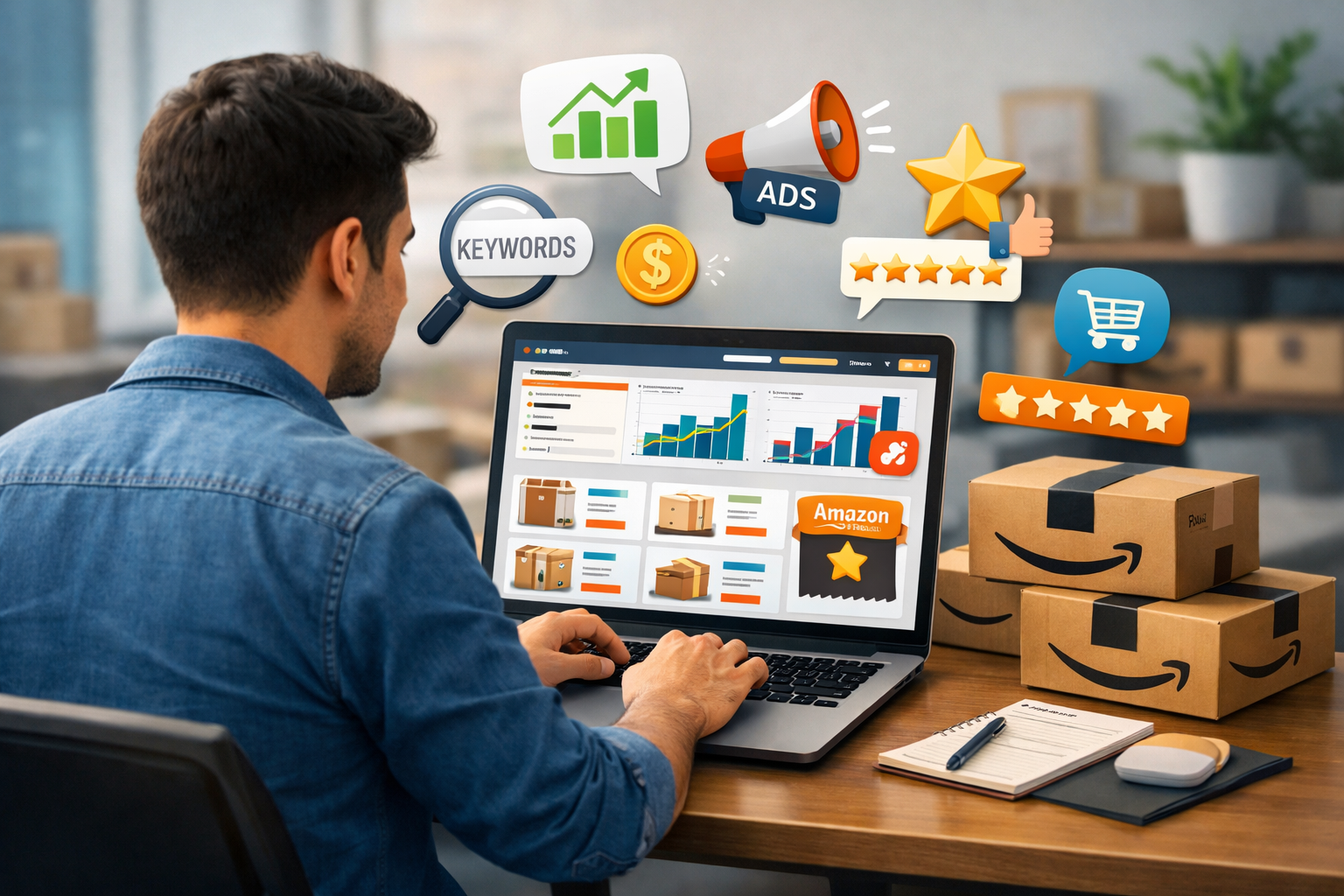
An online Amazon seller managing product listings, PPC advertising campaigns, and tracking sales growth using advanced marketing strategies in 2026.
Amazon Marketing in 2026: Complete Guide for Beginners
Introduction
Amazon in 2026 is not just an online marketplace — it is one of the most powerful digital marketing platforms in the world. Millions of customers search for products daily, and brands compete heavily to capture attention.
For beginners, Amazon marketing may look complicated. There are ads, algorithms, product listings, SEO, reviews, FBA, brand stores, and more. But once you understand the system step by step, it becomes much easier.
This complete beginner guide will explain everything clearly:
- How Amazon ranking works
- How to optimize listings
- How to run Amazon ads
- How to launch products
- Latest trends in 2026
- Common mistakes to avoid
Let’s start from the foundation.
What is Amazon Marketing?
Amazon marketing refers to strategies used to promote and sell products on Amazon using both organic and paid methods.
It includes:
- Product listing optimization (Amazon SEO)
- Amazon PPC advertising
- Sponsored Brands
- Sponsored Display ads
- A+ Content
- Amazon Storefront
- Deals & promotions
- External traffic marketing
In 2026, simply listing a product is not enough. You must actively market it.
How Amazon’s Algorithm Works in 2026
Amazon uses an advanced ranking system (commonly referred to as A10).
Amazon’s main goal is simple:
Show products that are most likely to generate sales.
Products rank based on:
- Sales velocity
- Conversion rate
- Click-through rate
- Keyword relevance
- Customer reviews
- Pricing competitiveness
- Seller performance
Important:
Amazon prioritizes performance over keywords. If your product converts well, it ranks higher.
Amazon SEO: Product Listing Optimization
Amazon SEO is the foundation of organic success.
Keyword Research
Keyword research is the first step. You can use:
- Helium 10
- Jungle Scout
- Amazon search suggestions
- Competitor analysis
- Brand Analytics
Types of keywords to target:
- Main keyword
- Long-tail keywords
- Buyer intent keywords
- Problem-solving keywords
Long-tail keywords convert better because they match specific buyer needs.
Example:
Instead of “Wireless Earbuds”
Use “Wireless earbuds with noise cancellation for gym”
Optimizing Product Title
Your title should include:
- Brand name
- Main keyword
- Key feature
- Size or variation
Keep it readable and natural. Avoid keyword stuffing.
Bullet Points Optimization
Bullet points should focus on benefits, not just features.
Good bullet structure:
- Problem
- Solution
- Benefit
- Emotional trigger
Clear formatting increases readability and conversion.
Product Description
In 2026, storytelling works better than plain descriptions.
Explain:
- Who the product is for
- What problem it solves
- Why it is better than competitors
Use persuasive language.
Backend Search Terms
Backend keywords help you rank for additional terms.
Rules:
- No repetition
- No commas needed
- Add synonyms
- Use all character limits
Amazon PPC Advertising
Paid ads are essential in 2026 due to competition.
There are three main types of Amazon ads:
Sponsored Products
- Most popular ad type
- Appear in search results
- Pay per click
- Best for beginners
Sponsored Brands
- Shows brand logo
- Displays multiple products
- Great for brand building
- Requires brand registry
Sponsored Display
- Retargeting ads
- Show on and off Amazon
- Advanced scaling strategy
Amazon PPC Strategy for Beginners
Start simple.
Step 1: Run Auto Campaign
Let Amazon find converting keywords.
Step 2: Analyze Data
After 1–2 weeks:
- Identify converting keywords
- Move them to manual campaign
Step 3: Optimize Bids
- Increase bids for profitable keywords
- Reduce bids for wasteful spend
Step 4: Add Negative Keywords
Block irrelevant searches to save money.
Product Launch Strategy in 2026
Launching correctly determines long-term success.
Before launch:
- Fully optimized listing
- High-quality images
- Competitive price
- At least a few reviews
- PPC campaigns ready
Launch strategy:
- Run aggressive PPC for first 2 weeks
- Offer coupons
- Use limited-time discounts
- Drive external traffic
Strong launch improves ranking quickly.
Importance of Reviews in 2026
Reviews directly impact:
- Conversion rate
- Trust
- Ranking
Ways to get reviews legally:
- Amazon “Request Review” feature
- Vine program
- Follow-up emails (policy compliant)
- Provide excellent customer service
Never buy fake reviews. Amazon strictly suspends accounts.
FBA vs FBM
FBA (Fulfilled by Amazon)
Amazon handles:
- Storage
- Shipping
- Returns
Benefits:
- Prime badge
- Higher trust
- Better ranking
Best for beginners.
FBM (Fulfilled by Merchant) – Amazon Marketing in 2026
You handle shipping.
Best for:
- Large items
- Low-margin products
In 2026, FBA is still more beginner-friendly.
Brand Building on Amazon – Amazon Marketing in 2026
If you want long-term success, build a brand.
Brand Registry
Benefits:
- A+ Content
- Sponsored Brands ads
- Brand Analytics
- Protection from hijackers
A+ Content
Add:
- Lifestyle images
- Comparison charts
- Visual storytelling
A+ can increase conversion rates significantly.
Amazon Storefront – Amazon Marketing in 2026
Create a branded mini website inside Amazon.
Helps in:
- Brand trust
- Cross-selling
- Better customer experience
Driving External Traffic – Amazon Marketing in 2026
Amazon rewards sellers who bring traffic from outside.
Sources:
- YouTube
- Influencer marketing
- Google Ads
Use Amazon Attribution links to track performance.
Common Beginner Mistakes – Amazon Marketing in 2026
- No proper keyword research
- Poor product images
- Not running ads
- Ignoring data
- Overpricing
- Giving up too early
- Not calculating profit margins
Avoiding these mistakes increases your success rate.
Amazon Marketing Trends in 2026 – Amazon Marketing in 2026
- AI-based ad optimization
- Video-focused listings
- Voice search optimization
- Influencer-driven launches
- Micro-niche branding
- Data-driven scaling
- Subscription models
Sellers who adapt to trends grow faster.
How Much Budget Do You Need? – Amazon Marketing in 2026
Beginner estimate:
Inventory: ₹50,000 – ₹1,50,000
PPC marketing: ₹15,000 – ₹40,000
Branding & creatives: ₹10,000+
Starting seriously may require ₹75,000 to ₹2,00,000 minimum.
Step-by-Step Beginner Roadmap – Amazon Marketing in 2026
Month 1:
- Product research
- Supplier sourcing
- Profit calculation
Month 2:
- Branding & listing creation
- Inventory shipment
Month 3:
- Launch with PPC
- Collect reviews
- Optimize ads
Month 4–6:
- Scale winning keywords
- Expand variations
- Improve conversion rate
Is Amazon Marketing Worth It in 2026?
Yes — but only if treated like a real business.
Amazon is competitive but still highly profitable for sellers who:
- Focus on customer satisfaction
- Optimize listings continuously
- Analyze ad data
- Build a brand
- Think long-term
AI Search Optimization Tools: How They Increase Organic Traffic and Improve Search Performance
Introduction
In today’s competitive digital landscape, simply creating a website or publishing content is no longer enough. Every business, blogger, and brand wants to appear at the top of search engine results. This is where AI Search Optimization Tools play a crucial role.
Artificial Intelligence (AI) has completely transformed Search Engine Optimization (SEO). What once relied heavily on manual keyword research, guesswork, and delayed insights is now driven by real-time data, automation, and predictive analysis. AI-powered tools help marketers understand search behavior, optimize content, and make smarter SEO decisions.
Final Conclusion – Amazon Marketing in 2026
Amazon Marketing in 2026 is about strategy, data, and optimization.
Success does not come from listing products randomly. It comes from:
- Smart keyword research
- Strong product optimization
- Strategic PPC campaigns
- Brand building
- Consistent improvement
If you stay patient and keep optimizing, Amazon can become a powerful income source.